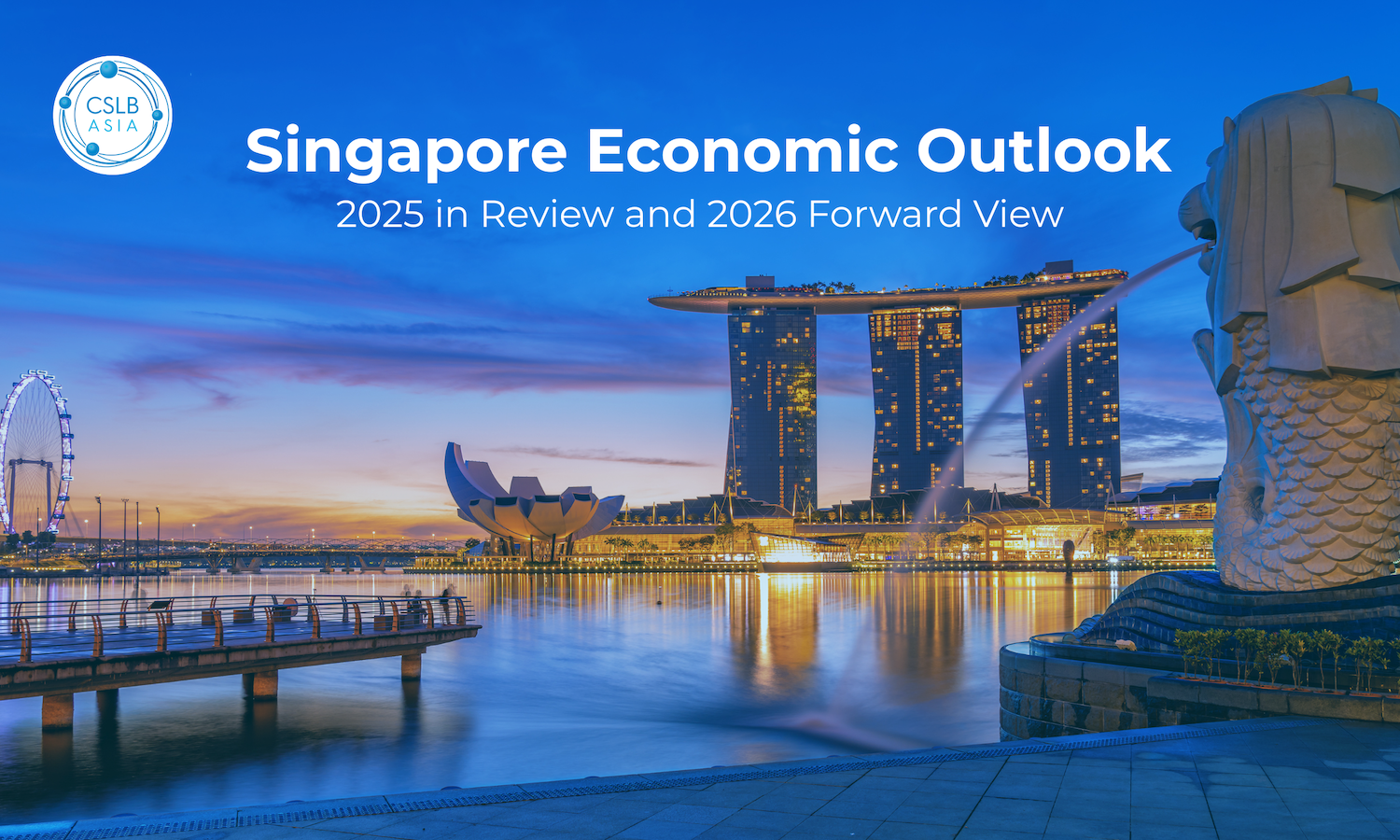
Singapore Economic Outlook: 2025 in Review and 2026 Forward View
As 2025 draws to a close, businesses in Singapore are reflecting on a year marked by both economic transition and regulatory reform. At CSLB Asia, we have observed a shift in policy enforcement, market structure and leadership expectations. In this article, we explore key developments that shaped the business environment in 2025 and what forward-looking firms should prepare for in 2026. Anchored in the Singapore economic outlook, this article offers directors, entrepreneurs and compliance leaders a practical guide to managing risk, regulation and informed decision-making.
Regulatory Compliance in 2025
The momentum of change in regulatory compliance accelerated in 2025. Across corporate governance and reporting obligations, agencies have been focusing more on whether companies followed proper processes and if directors met their responsibilities.
CSLB Asia supported a record number of clients in meeting their annual return deadlines on time. Filing through BizFile+ was significantly faster due to ACRA's interface upgrades earlier in 2025. The updated system made it easier for CSLB Asia to guide our clients through complex filings with greater speed and accuracy.
A notable shift emerged in the treatment of work passes. Under the COMPASS framework, renewal applications for Letters of Consent (LOCs) faced increased scrutiny. Across the industry, some LOC applications were rejected despite established employment histories. This signals a clear call for directors to ensure strong role justification when applying under the COMPASS framework. With this level of scrutiny likely to continue into 2026, early preparation and accurate supporting documents will be essential.
The Singapore economic outlook remains strong, but growth will depend increasingly on operational excellence and compliance maturity. Regulatory compliance has become a standard of leadership, not just administration.
Director Duties and Liabilities
Singapore continued to strengthen corporate governance standards in line with global best practices and local enforcement priorities. In 2025, Parliament introduced heavier penalties for breaches of director duties. The maximum fine for statutory breaches was raised to S$20,000, while more serious offences involving dishonesty or negligence may attract criminal charges, including imprisonment. This reinforced the central role of directors in upholding legal and fiduciary responsibilities.
It is important to note that these changes are not procedural in nature. They reflect a deeper commitment to director-led accountability. Directors can no longer rely on corporate secretaries to bear operational responsibility. For example, under the revised interpretation of Companies Act obligations, the roles of company director and secretary must be held by separate individuals. This change is subtle but critical. It elevates the governance burden from the corporate secretary and shifts risk directly onto directors.
CSLB Asia has seen a rise in clients rethinking the structure of their compliance support with the growing complexity of governance risk. Greater awareness of director duties across all levels of the company for long-term compliance success has become essential.
ACRA Enhancements and Public Transparency
Among the most welcomed developments in 2025 was the expansion of digital access to company records. We shared an in-depth article about the updates earlier this year.
Through ACRA’s updated BizFile+ portal, public inspection of certain documents became easier, faster and more transparent. This aligns with Singapore’s pro-transparency stance and benefits investors conducting due diligence.
From a regulatory compliance perspective, this digital shift reduces administrative friction and increases visibility. Directors should be aware that errors or outdated records are now more easily discovered by stakeholders, including regulators, clients and partners. Accurate and well-maintained records are now essential to reputational strength and regulatory confidence.
This reflects a broader theme in Singapore’s economic outlook. As the city-state continues to position itself as a global headquarters destination, its regulatory systems must be digitally advanced and internationally credible. Sustained attention to regulatory compliance is part of that positioning.
The 2026 Landscape: Anticipating Risks and Requirements
Looking ahead, the Singapore economic outlook for 2026 remains cautiously optimistic. Growth will be shaped by global uncertainty, technology integration and rising governance expectations. For businesses that prioritise regulatory compliance and operational readiness, the opportunities remain strong.
Workpasses
Workpass requirements are expected to tighten further along with the annual review of the salary benchmarks. The COMPASS framework, while designed to support transparent employment evaluation, is evolving. Employers should expect stricter thresholds and deeper scrutiny of role-based justifications. CSLB Asia encourages clients to prepare employment documentation early and seek pre-submission reviews where possible.
We previously shared a comprehensive overview of these workpasses in Singapore, which remains relevant as the policy direction has remained consistent. Read the full article here.
Regulatory Compliance
In the broader regulatory compliance space, we expect continued alignment with global reporting standards, such as ESG, which refers to environmental, social and governance factors used to assess business practices like energy use, employee welfare, board conduct and risk controls. This would mainly be for companies working with banks, MNCs or government-linked entities. While direct obligations may not apply to SMEs, indirect pressures are likely to rise.
Continued Incorporation of AI
AI adoption will continue to be another defining theme of 2026. Firms that integrate AI in accounting, HR and operations are likely to benefit from efficiency, accuracy and early risk detection. CSLB Asia is working closely with selected partners to support safe and strategic AI deployment across key corporate functions so we can serve our clients better.
We wrote an in-depth article earlier this year about AI governance, compliance and the risk of data breaches, you can read the full article here. We strongly recommend using the PDPC’s ToolBox as a starting point for building your internal data policies, which CSLB Asia can then review to ensure they are complete, coherent and compliant.
Singapore Economic Outlook
The Singapore economic outlook in this respect is innovation driven. Businesses that invest in structured transformation, including digital tools, process automation and clear internal controls, will be better positioned to adapt and scale. Economic outlook indicators suggest continued demand for leadership that understands both digital operations and regulatory compliance. Directors and senior managers who can align technology with governance will play a critical role in sustaining growth and protecting the business.
Director Duties
Director duties will also continue to evolve. In 2026, directors must stay current with both legal requirements and and the everyday decisions that shape how their business is managed. Ongoing review of internal controls, record-keeping and policy implementation will be necessary. Leadership teams should consider board training sessions and deeper collaboration with professional advisors. The Singapore economic outlook increasingly favours companies that can demonstrate leadership in both regulatory compliance and director fulfilling their duties under the Companies Act.
Rising Costs, Real Decisions
Operating in Singapore remains attractive, but cost pressures are growing. Inflation, geopolitical risks and tariff uncertainty will affect everything from logistics to staffing. This will be most acutely felt in compliance and HR. As governance obligations rise, more firms will move away from bundled corporate service packages toward modular or on-demand solutions.
Directors must weigh cost efficiency against doing things properly and meeting compliance standards. Cutting corners on documentation or leaving compliance entirely to administrative staff is no longer viable. Director duties are well defined and clearly laid out, making it easy for directors to understand their responsibilities and enforcement has become more active. Putting the right governance in place reduces risk and protects decision-makers.
Regulatory compliance is becoming a strategic asset. Businesses that take it seriously reduce risk, build trust and stay competitive, especially in fast-moving industries or those expanding across borders.
Positioning Your Business for 2026
In summary, 2025 was a year of tightening and transformation. From stricter enforcement of the COMPASS framework to increased director duties, the tone from regulators is clear. Compliance is now a leadership issue, not an operational one.
The Singapore economic outlook remains strong for those prepared to act. CSLB Asia urges directors and business leaders to revisit their governance models, strengthen internal documentation and prepare for continued evolution in 2026.
By focusing on regulatory compliance, understanding director duties and leveraging frameworks like COMPASS, your organisation can enter 2026 with clarity and control.
CSLB Asia remains committed to helping you stay compliant, agile and informed in the year ahead. If you would like support with restructuring and support with your compliance, we offer a free introductory call. Book your free introductory call here.